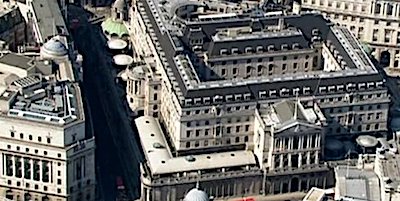
The UK central bank raised interest rates for the first time in over three years on Thursday and warned that at least one more increase is likely if the US-Iran conflict continues.
The central bank’s Monetary Policy Committee voted 8-1 to raise rates to 4% from 3.75%.
Policymaker Catherine Mann voted for a half-point interest rate increase to 4.25%.
UK central bank governor Andrew Bailey said: “Today’s increase shouldn’t be seen as the first in an inevitable long sequence of hikes.
“But unless the conflict in the Middle East is resolved, neither does it seem likely to be the last increase.”
UK inflation is likely to reach around 5% in the middle of next year, the Bank of England said, more than double the central bank’s target.
“Without news which softens the risks to inflationary pressures, I can see the argument for a further increase in rates,” said Bailey in the policy minutes.
Deputy Governor Clare Lombardelli said a further rate hike was likely to be needed in the near term.
External MPC member Megan Greene and Chief Economist Huw Pill talked of a need for “further tightening” and “additional hikes” respectively.
MPC members Swati Dhingra and Alan Taylor said they would need stronger evidence of second-round effects before backing more tightening.
REACTION:
Felix Feather, Economist, Aberdeen: “The Bank of England’s decision to deliver a 25bps hike was widely expected. And there were few fireworks to be found in the communication of the decision: Catherine Mann’s dissenting vote to hike by 50bps caught the eye, as did Governor Andrew Bailey stating that rates were likely to move higher still unless the Iran war was resolved.
“From here, the question is whether the hiking cycle will rocket or quickly fizzle out.
“We think it probable that market pricing for a further three hikes might overstate the case for further tightening, especially given energy market strains have eased a little since Tuesday and the US midterm results.
“But we do see at least one further hike, probably coming in February next year. That relatively shallow tightening cycle could leave some space for UK assets including gilts to rally.
“However, a return to US strikes against Iran or a rise in domestic political uncertainty poses downside risk to this view.”
James Flintoft, head of investment solutions at AJ Bell: “The Bank of England has delivered its first rate hike of this cycle, which has been long-awaited by cash savers and those invested in money market funds.
“While the BoE has waited longer than some of its counterparts, it’s now expected to move further, with markets suggesting we will see at least two hikes by September 2027. Whether or not the economy can withstand those hikes remains to be seen, and in time the Bank may be forced to veer from this path.
“The gilt market has been pricing in rate hikes for some time, firstly following the escalation in Iran earlier this year and then more recently with the 2 year gilt yield approaching 5%. This contrasts with the expectations at the start of 2026 that we would see a series of rate cuts from the BoE.
“Investors have been enjoying the tax advantage of low coupon gilts and the move higher in yields this year has served to make their tax equivalent yields even more attractive, if held to maturity.
“Capital gains on gilts are tax free, with only the coupons taxable at the holder’s marginal rate. This is an advantage over typical interest bearing accounts and fixed rate bonds, where all of the return is taxable as income. Combined with the ability to ladder gilt maturities in line with anticipated spending, gilts have been a very interesting financial planning tool.
“We’ve used this strategy in our AJ Bell Gilt MPS to allow advisers a way to access the market without needing to delve into the details of gilts themselves, which can be complex to understand.
“Elsewhere, people that have been utilising cash and equivalents, often for shorter term or unpredictable spending needs and emergencies, have been best served by money market funds. They’ve swelled in popularity in recent years as an alternative to a cash savings account that still offers a large amount of liquidity without as much hassle in shopping around for the best rates.
“The yields here have languished relative to the gilt market, as they reflect very short-term interest rates, however the move in the base rate today improves the returns earnt on that cash stashed away. Yields in this part of the market track the base rate, so the 25bps rise to 4.0% lifts returns within days, as holdings roll into higher rates as they mature.
“The change in market expectations, from forecasts for three hikes in the next year just a week ago to two now, has come in response to easing oil prices. This has led to government bond yields falling from their recent peaks, a move captured by those who bought gilts in recent weeks. It is a useful reminder that cash savings can miss out when markets move. Higher rates help cash returns, but they can change quickly and may not keep pace with inflation.”
Julian Jessop, Economics Fellow, Institute of Economic Affairs: “The Bank of England’s decision to raise interest rates this week is an insurance hike to get ahead of the upside risks to inflation and preserve some credibility.
“This is not necessarily the start of a prolonged hiking cycle. With a bit of luck, especially on energy prices, rates may not have to be raised much further and this could even still be a case of ‘one and done’. But it is worrying that borrowers are having to pay the price for years of failed energy policies.
“This forecast may be too pessimistic, depending especially on what happens to energy prices. But there is no doubt that the risks relative to the 2% inflation target are firmly skewed to the upside.
“MPC members rightly emphasised the importance of ‘risk management’ and ‘credibility’. It is better to send a clear signal by getting ahead of the inflation risks now, rather than having to respond with even bigger rate increases later.”
David Bharier, Deputy Director at the British Chambers of Commerce: “With inflation forecast to hit 5% next year, the Bank wanted to show it will act to stop price increases becoming entrenched.
“But the current rise in inflation is largely driven by energy costs from the conflict in Iran, not an overheating economy. Our data shows that now only 17 per cent of firms are increasing investment. If there are signs of de-escalation in the months following the midterm elections, and energy prices steady, a rate rise may prove premature.
“So far, there is little sign of the wage-price spiral the Bank is looking to guard against. Unemployment is higher than in 2022, the labour market is looser, and our research shows AI adoption accelerating rapidly – with some of the deepest users more likely to expect headcount reductions.
“A rate rise is an insurance policy against the spiral. But after a Budget which gave businesses little incentive to invest, and with borrowing costs already high, it is economic growth that will pay the premium.”