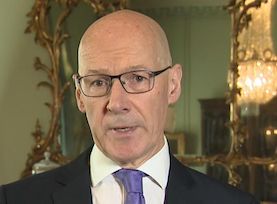
The SNP has won a fifth successive Scottish Parliament election with 58 seats — but fell short of the 65 seats required for an overall majority at 129-member Holyrood.
Labour and Reform finished a distant second, tied on 17 seats. The Scottish Greens won 15 seats, including their first ever constituency victories.
The Conservatives experience their worst ever Scottish Parliament election result to finish with 12 seats. The Liberal Democrats won 10 seats.
The results mean there is a majority of parties at Holyrood who support Scottish independence, with the SNP and the Greens controlling 73 of the 129 seats.
The far-right Reform UK did not win a single constituency in the Scottish election. Its 17 seats were won via the Scottish Parliament’s “regional list” second vote seat system — which uses the d’Hondt system of proportional representation — in which it polled 16.6%.
Reform UK’s Scottish leader Malcolm Offord failed by some distance to win the Inverclyde seat, coming third with 17.6% of the vote, behind Labour’s Francesca Brennan in second place with 27.7% and the SNP’s Stuart McMillan in first place with 44.3%. Nonetheless, Offord has been elected as a “regional list” MSP for West Scotland under the d’Hondt system.
The SNP is expected to return to government — but it will require help from other parties to pass legislation and to reinstall John Swinney as first minister.
Swinney said that a result of the SNP’s “commanding” position “the public expectation will be for me to be returned as first minister and to lead a government.”
Swinney has ruled out any negotiations with Reform UK.
Of the 73 constituency first-past-the-post seats, the SNP won 57, the Liberal Democrats won seven, the Conservatives won four, Labour won three, and the Scottish Greens won two.
Despite winning 57 of the 73 constituency seats, the SNP’s share of the constituency vote fell 9.5% to 38.2%. The Conservatives’ share of the constituency vote fell 10.1% to 11.8%, and Labour’s share of the constituency vote fell 2.4% to 19.2%. The Liberal Democrats’ share of the constituency vote rose 4.4% to 11.4% and the Scottish Greens’ share of the constituency vote rose 1% to 2.3%. Reform UK’s share of the constituency vote was 15.8%.
Of the 56 “regional list” second vote seats — allocated using the d’Hondt system of proportional representation — the SNP won 27.2% of the vote but were allocated just one regional seat, while Labour won 16% of that vote and were allocated 14 regional seats, Reform won 16.6% and were allocated 17 regional seats, Scottish Greens won 14% and were allocated 13 regional seats, Conservatives won 11.8% and were allocated eight regional seats, and Liberal Democrats won 9.4% and were allocated three seats.
Swinney told a news conference in Edinburgh that the SNP was by a “country mile” the leading party in the Scottish Parliament and would form the next government. He said the leaders of all other parties in the Scottish Parliament would be invited individually soon to talks, except for Reform.
Swinney said: “It is vital that we unite in Scotland to ensure our parliament is fully Farage-proofed.
“That means having the power before 2029 to decide our own constitutional future without Farage being able to block us.”
Swinney said his ambition of holding a referendum on Scottish independence in 2028 was realistic.
“There has now been a pro-independence majority for four elections in a row but this mandate has been ignored by both Labour and Tory prime ministers year after year,” Swinney said.